GoodlifeNews!

Exploring a Potpourri of Biblical Ideas and Godly Living

Greetings once again friends! This is Episode Eight of the podcast. The title of this week’s episode is “The Lord’s Prayer, Part II.”
This is the second of a two-part series focusing on the meaning of several key expressions in the prayer Jesus taught his disciples. Click HERE for a link to the audio podcast.

Jesus teaching his disciples.

Introduction to the Episode

In Episode 7 last week, we considered four phrases Jesus used in his model prayer.

  1. “Our Father, which art in heaven” — Our Father God is worthy of our love, loyalty, devotion, and worship.
  2. “Hallowed be Thy Name” God’s Name is holy, and must be spoken only in context of reverence and respect.
  3. “Thy Kingdom Come” The Kingdom God is a kingdom of both Grace and Glory. The Kingdom of Grace begins in the here and now. The Kingdom of Glory will be established after the return of Jesus.
  4. “Thy Will be Done” God’s will is revealed in His Word—the Holy Bible.


Today, in Part II of our study, we will examine four more of those key phrases.

  1. “Our Daily bread”
  2. “Forgive Us as We Forgive Others”
  3. “Deliver Us from Evil”
  4. “The Kingdom, Power, and Glory”

It is interesting to note that The Lord’s Prayer has a specific structure that is helpful to understand. It is naturally divided into three sections:

  • Praise
  • Petition
  • Honor

The first three of the four phrases we are looking at today constitute the “Petition” portion of the prayer.

The fourth finishes the prayer with the highest expression of honor to God the Father to whom the prayer is directed.


“Our Daily Bread”

The “Petition” portion of this model prayer begins with “Give us this day our daily bread.”

I want to look at what in included in the “bread” Jesus says we should pray for, but first, let’s note that God the Father loves to hear our prayer requests—and loves to grant them!

Here are a couple texts to reinforce our understanding about that:

  • Philippians 4:6 — “Let your requests be made known to God.”
  • Matthew 7:11 — “If you sinful people know how to give good gifts to your children, how much more will your heavenly Father give good gifts to those who ask him” (NLT).

With those promises in mind, what is meant by “Our Daily Bread?”

It seems reasonable to believe that the “bread” Jesus is talking about includes anything related to our basic needs in life. Things like food, of course, but also shelter, clothing, etc. I believe it also includes the many blessings God has in store for us—and for others—such as the needs of family members, friends, even government officials, and church leaders.

In other words, Jesus teaches us that it’s okay to ask for and receive the answers to our everyday needs. Every day is a different day with different needs. Daily requests form daily relationships with the Father who loves us and truly wants to connect with us.


“Forgiveness as We Forgive Others”

Verse 12 of Matthew chapter 6 says, “Forgive us our debts, as we forgive our debtors” (KJV).

I find it significant that this prayer is central to both the “Petition” section—and to the entire prayer itself.

The very idea—the core concept—of forgiveness is the heart of the gospel! It is the essence of the “everlasting gospel” shouted by the first angel of Revelation 14:6-7. Forgiveness is the single, most basic ingredient needed for healthy, life-giving relationships in this world. Forgiveness is the antidote to bitterness and anger.

I’m not sure who said it first, although I’ve used the statement many times:

“Bitterness is a poison you drink hoping your enemy will die.”

When someone wrongs us, it is our natural human nature to strike back. The only way we can “get even” is to hurt that person back with equal or more force than what we received. Does that bring healing to the relationship? No. Not at all. In fact, the most probable result will be a deepening of resentment, an intensifying of anger, and stronger fortification of entrenched alienation! When will enough be enough?

“Getting even” literally means “to justify.” A perfect example is on nearly every page of every book, article, or other printed material you can name. The vast majority of our reading matter, regardless of the medium, is “justified” on the left margin of the text. Many times, both margins are justified, e.g. most newspaper columns.
To be justified spiritually means that our spiritual record is brought into perfect alignment with God’s standard—the Ten Commandments.

The problem confronting us, however, is that because of sin we are out of alignment! We need to be restored to God’s standard: namely, sinlessness. And, we are totally helpless to get to that state on our own. No amount of strict, flawless obedience on our part now or in the future can erase our past record of sinfulness.

Our only hope is forgiveness. God’s forgiveness. God’s making us all over again into a new creation—perfect in Christ.

Here’s an incredible truth penned by the Apostle Paul in his letter to the church at Colosse:

“You were dead because of your sins and because your sinful nature was not yet cut away. Then God made you alive with Christ, for he forgave all our sins. He canceled the record of the charges against us and took it away by nailing it to the cross” (Colossians 2:13-14 NLT).

So then, we must forgive others, even as God has already forgiven us. If we harbor unforgiveness, anger, bitterness, or resentment against those who wronged us, we block the channel, so to speak, for receiving God’s gift of justification by his amazing grace. Thus, the admonition of Jesus in the model prayer, that we must forgive the sins which others have committed against us in order to open the doors to forgiveness—justification—from our Father God


Let’s go on now to the next phrase in the Lord’s Prayer:

“Deliver Us from Evil”

I really like the way several different translations present the message of this phrase.

The traditional King James Version, of course, says, “Lead us not into temptation, but deliver us from evil.

The NKJV expands that to, “Do not lead us into temptation, but deliver us from the evil one.

And, one of the popular paraphrase editions of the Bible—The Message—says, “Keep us safe from ourselves and the Devil.

But, my most recent “favorite” Bible translation says, “Don’t let us yield to temptation, but rescue us from the evil one” (Matthew 6:13 NLT).

I presume that most listeners/readers of GoodlifeNews! Podcast and Blog have read, memorized, and repeated the Lord’s Prayer many times—probably even hundreds of times. All the phrases and expressions are so familiar that they are easily spoken from rote repetition without ever stopping to actually think about a deeper meaning.

And, that seems especially true with this one—“lead us not into temptation. Deliver us from evil.” However, as we dig down into this teaching of Jesus, we discover some wonderful truths hidden just below the surface.

For instance . . .

What is the nature of “temptation?”

Have you ever been traveling and running late? You’re speeding along doing the best you can to make up for lost time. Then you see what looks like a great shortcut.

“Excellent!” you think. “This will save me a lot of miles!”

You wish!

What you thought was a shortcut turned out to be “the scenic route,” and you lost more precious minutes than if you had just stayed on the main road.
How many times I have been there and done that!

Simply put, a temptation is what appears to be a faster, easier way to reach your destination. Except, in reality, shortcuts rarely work out as expected. Especially in realms of the spirit.

Now, consider this: The very idea of “temptation” presumes a moral nature of human beings.

In the story of Genesis 3:6, Eve “saw” [understood] that the tree was good—for food, for beauty, for wisdom. All those things were good within themselves. The arch-deceiver knew that. He knew that the Creator God would provide all those good things to Adam and Eve. What he offered was a shortcut—an easier, quicker, more direct route—but to take this new, supposedly “better” way, they had to make the choice to trust him more than they trusted God.

Sadly, they yielded. They ate the forbidden fruit. Their moral integrity was shattered by their disobedience. And the world still reels in the consequences.

Temptations are a natural part of life for all free-moral agents. Temptations themselves are not sin. Hebrews 4:15 tells us that Jesus was “in all points tempted as we are, yet without sin.”

Then, the next verse—Hebrews 4:16—encourages us by saying,

“Let us therefore come boldly to the throne of grace, that we may obtain mercy and find grace to help in time of need.”

In next week’s episode, I will be sharing some thoughts about our personal practices—habits—of prayer. I believe God wants us to grow ever deeper in our prayer life as our spiritual journey advances. I pray that as I share some of my thoughts and experience, that it will bring encouragement to you to “come boldly to the throne of grace.”


“The Kingdom, Power, and Glory”

This last expression in The Lord’s Prayer completes the structural trio of Praise, Petition, and Honor.

Perhaps this would be a good place to note that this phrase is missing from the very earliest New Testament manuscripts. It was apparently added later as a “doxology” at the end of the prayer—maybe as early as the 2nd century AD. Some have suggested it may have been a musical ending to the prayer added by devout followers of Jesus.

Whatever the case, the thoughts expressed in this phrase are indeed a fitting example for how to finish our personal devotionals. I love the words, and, frankly, my heart soars when I direct them heavenward to my Father.

There’s a lot more that can—and should—be said here. But with limited space and time I’ll need to condense my thoughts as much as possible.

Let’s briefly take each of the three words in this doxology one-by-one.


“Kingdom”

In last week’s episode, we looked at several aspects of the “Kingdom of God.” We noted that there are two manifestations—the Kingdom of Grace, and the Kingdom of Glory.

Here, in this summary statement honoring God at the end of his model prayer, Jesus helps us stay in the right relationship with the Father. He is God. We are not. The Kingdom belongs to Him—not to us (although we have the supreme privilege of being part of His Kingdom—both the Kingdom of Grace and the Kingdom of Glory).

Revelation 1:6 tells us that Jesus “has made us kings and priests to His God and Father” (NKJV).


Which brings us to the next word,

“Power”

The Apostle Paul wrote to the church at Rome,

“I am not ashamed of the gospel of Christ for it is the power of God to salvation for everyone who believes” (Romans 1:16).

And to the believers in Corinth he wrote,

“Jews request a sign and Greeks seek after wisdom; but we preach Christ crucified, to the Jews a stumbling block and to the Greeks foolishness, but to those who are called, both Jews and Greeks, Christ the power of God and the wisdom of God” (1 Corinthians 1:22-24).

Two words in Greek are both translated into English as “power.”

One type of power is authority. Jesus used this word when he told his disciples after the resurrection, “All power (authority) is given unto me in heaven and in earth” (Matthew 28:18 KJV).

The other word “dunamis” means the power of moral or physical strength. That’s the word that is used in both of the texts above. It is the same word used in the doxology phrase at the end of The Lord’s Prayer.

To use this expression at the end of the prayer—or even at the end of our own, personal prayers following the model taught by Jesus—is to acknowledge that even whatever moral or physical strength we may believe to be our own, actually belongs to God the Father, who bestows it upon us as another gift of his grace.


“Glory”

And, of course, all the “glory” of the Universe belongs to the Great Creator God.

“The heavens declare the glory of God; and the firmament shows His handiwork” (Psalm 19:1 NKJV).

“It is God who commanded the light to shine out of darkness, who has shone in our hearts to give the light of the knowledge of the glory of God in the face of Jesus Christ. But we have this treasure in earthen vessels, that the excellence of the power may be of God and not of us” (2 Corinthians 4:6 NKJV).

As a final thought, here is a beautiful description of our calling, written by Peter, the Lord’s disciple and powerful preacher of grace:

“You are a chosen people. You are royal priests, a holy nation, God’s very own possession. As a result, you can show others the goodness of God, for he called you out of darkness into his wonderful light” (1 Peter 2:9).


Thank you so much for listening today! I pray you have been blessed.

I hope you can join me for next week’s episode. I’ll be sharing some thoughts about our personal practices of prayer in today’s busy world.
Be sure to tune in, and if you enjoy these Podcasts and Blogposts, please share with your friends, family, or whomever! My many thanks—in advance! God bless.


Greetings once again friends! This is Episode Seven of the podcast. The title of this week’s episode is “The Lord’s Prayer, Part I.” This is the first of a two-part series focusing on the meaning of several key expressions in the prayer Jesus taught his disciples. Click HERE to listen to the audio podcast.

First, a word about the series:

You may have noticed the sub-title on the masthead of the GoodlifeNews! blog website, which reads, “Exploring a Potpourri of Biblical Ideas and Godly Living.” A parallel line on the Podcast home page says, “A Weekly Podcast of Biblical Themes and Abundant Christian Living.”

In one of Jesus’ parables in which he identifies himself as “the Good Shepherd,” he says,

“I have come that they [his “sheep” i.e. his “followers”] may have life, and that they may have it more abundantly” (John 10:10 NKJV).

There are very few truly vital components to “abundant” Christian living, but one of these “indispensables” is daily connecting with God in prayer.

A well-known Christian author, writing back in the 19th century, expressed it this way:

“Why should the sons and daughters of God be reluctant to pray, when prayer is the key in the hand of faith to unlock heaven’s storehouse, where are treasured the boundless resources of Omnipotence?” (Steps to Christ, 94-95, by Ellen G. White).

Think about that phrase: “Unlock heaven’s storehouse!” What an awesome concept is that! It inspires me to believe we could do well to spend some time studying the “Model Prayer” that Jesus taught the disciples. So, this week and next week I’ll be sharing several significant highlights which have blessed my own prayer experience.

I trust these thoughts may also be an encouragement to you.


In Luke’s Gospel, the story is introduced this way:

“Now it came to pass, as [Jesus] was praying in a certain place, when He ceased, that one of His disciples said to Him, ‘Lord, teach us to pray, as John also taught his disciples’” (Luke 11:1).

In Matthew’s account of Jesus’ life and teachings, the model prayer Jesus shared with the people that day is included in a longer passage found within the “Sermon on the Mount,” where he also gave some other rich instructions about prayer practices and attitudes. You can read those in Matthew 6:5-8.

Our study focus for these two weeks will be on Matthew 6, verses 9-13, and—because of the rich traditions and poetic power of these verses in the King James Version—I will be using that version.

Here are those familiar words:


Our Father which art in heaven,
Hallowed be thy name.
Thy kingdom come.
Thy will be done in earth, as it is in heaven.
Give us this day our daily bread.
And forgive us our debts,
As we forgive our debtors.
And lead us not into temptation,
But deliver us from evil:
For thine is the kingdom, and the power, and the glory, forever.
Amen.


So, let’s take a closer look at a few of those significant phrases. We begin with . . . .

Our Father

The Greek expression translated here is pater hemon. Literally, it means “Father of us all.” It is notable that before Jesus told them what the content of their prayers should include, he first directed their focus to the Heavenly Father to whom they should direct their prayers.

The “Father” is the Source of all being, and the Fountain of all existence. He is El Shaddai, the Hebrew term meaning the One from whom comes every good and perfect gift. He is never weary of pouring forth His mercies on His people, and He is more ready to give than they are ready to receive.

The Apostle James (a half-brother of Jesus) writes,

“Every good gift and every perfect gift is from above, and comes down from the Father of lights, with whom there is no variation or shadow of turning” (James 1:17).

And, here’s what Dr. Luke recorded from Jesus,

“If a son asks for bread from any father among you, will he give him a stone? Or if he asks for a fish, will he give him a serpent instead of a fish? Or if he asks for an egg, will he offer him a scorpion? If you then, being evil, know how to give good gifts to your children, how much more will your heavenly Father give the Holy Spirit to those who ask Him!” (Luke 11:11-13).

In the Sermon on the Mount, Jesus concluded his teaching about prayer and trust with these words,

“Do not worry, saying, ‘What shall we eat?’ or ‘What shall we wear?’ . . . . Your heavenly Father knows that you need all these things. But seek first the kingdom of God and His righteousness, and all these things shall be added to you” (Matthew 6:31-33).


Hallowed be Thy Name

Directly related to Jesus’ injunction that our first spiritual pursuit should be focused on the kingdom of God and his righteousness, is this expression of respect and reverence for our Father-god.

To “hallow” something is to regard it as holy—sacred. The name of God is HOLY, and should be spoken or used only in reverence and respect.

When I was young, the casual, or non-spiritual use of God’s name was considered “out-of-bounds” for general, or just common conversation. Expressions we often hear today such as “OMG!” (verbal shorthand for “Oh, My God!”), or “For God’s sake!” probably are not usually said with a sense of God’s holiness.

Now, I want to be clear. I count myself as no one’s moral judge. Every person’s words and actions are judged by the only One who can look into every mind and heart, and know the spirit behind them. However, as a minister of God’s grace, it is important for me to bring things like this to your attention. I would only encourage you to think carefully and prayerfully about your own daily conversations and conduct.

And, as I constantly say, the choice is yours. As for me, I can honestly tell you that when I invited the Lord into my heart for the first time at age 16, He began the process of cleaning up my language, and for that I am truly grateful. That process has continued throughout my entire life since then—and still continues every day, even now. I can, in all honesty say, I want nothing more than for my life and influence to only count for his kingdom.

There is much yet to be said, but before we go on to the next expression in The Lord’s Prayer, here are a few truths I want to share with you about our Father in Heaven.

  • God loves you.
  • In Christ, the Father forgives ALL your sins and declares you innocent. (See 1 John 1:9).
  • The Father adopts you into his Family and gives you his Name.
  • The Father invites you today, “Come home!”

Thy Kingdom Come

With those thoughts in mind, lets take a look at the next phrase in the Lord’s Prayer, “thy kingdom come.”

To understand what Jesus was talking about here in this instruction, we need to notice something else he said about the kingdom.

Once, having been asked by the Pharisees when the kingdom of God would come, Jesus replied, “The kingdom of God does not come with your careful observation, nor will people say, ‘Here it is,’ or ‘There it is,’ because the kingdom of God is within you” (Luke 17:21 NIV).

Now, it’s true, the Bible is clear: Jesus’ eternal kingdom (ref. Daniel 2:44) will be established here on earth only after his Second Coming when he returns as King of Kings and Lord of Lords. However, the Scripture is also very clear that, in point of fact, his true kingdom—the kingdom of the heart—begins in the here and now.
His kingdom, however, is not the same as the current earthly kingdoms. He told Pilate, “My kingdom is not of this world. If it were, my servants would fight . . . . But now my kingdom is from another place” (John 18:36).

So, what we’re seeing here is that Jesus’ kingdom—the kingdom of God—is of an entirely different nature from the political kingdoms and nations we are all familiar with. Jesus’ kingdom—the one that begins for us now in this life and continues into our eternal experience in the Earth Made New—is not a kingdom established and defended by the force of arms, but instead is a kingdom of agápe love, grace, forgiveness, and joy.

And, Jesus very pointedly instructs his disciples—and we who are also his disciples today—to pray for that kingdom of love and grace to begin even now, before his return in the clouds of heaven. As we hear and respond to his invitation to follow him as our Lord (i.e. “King”) we are to become ambassadors for the kingdom to all who have not yet heard the good news of the Father’s love (the gospel). We, in fact, have a role to play in God’s answer to the prayer, “thy kingdom come.”

John the Revelator declares, “[Jesus] has made us kings and priests to His God and Father, to Him be glory and dominion forever and ever. Amen” (Revelation 1:6).

Peter writes, “You are a chosen generation, a royal priesthood, a holy nation, His own special people, that you may proclaim the praises of Him who called you out of darkness into His marvelous light” (1 Peter 2:9).


Thy Will be Done

Before we go on, let’s do a quick review of the ground we’ve covered here.

  • God the Father resides in a place called heaven.
  • He is the source of our being, the fountain of our existence.
  • His Name is to be reverenced and held in awe—it must never be spoken in vain.
  • God loves you and has already forgiven you of ALL your sins.
  • He invites you to put your complete trust in Him today.
  • The Kingdom of Glory will come when Jesus comes again.
  • The Kingdom of Grace has already begun.
  • We cannot enter the Kingdom of Glory unless we first live the Kingdom of Grace—i.e. extending grace to others as we ourselves have received grace from God.

Now, let’s look at the last phrase for our study today: “Thy Will be Done.”


How do we know God’s will? There are several ways we see as examples, both from Scripture and from personal experiences.

The most basic way to discover God’s will is to read the Bible.

Sometimes people might believe that what they feel, or a dream they have had, or impressions they receive are valid ways to determine God’s will for their lives. All of those might indeed be valid, but there is one standard by which all of them must be measured. That is simply: Do they conform to the written Word of God?

The only way to know the answer to that question is to read and study the Bible for yourself. This is where learning to use study tools such as Bible dictionaries, commentaries, and multiple translations becomes very valuable. These tools will not tell you WHAT to believe, but they will aid in providing legitimate insight into the background language(s) and expressions used by the Bible writers.

However, it is not enough just to know what the Bible says—or even to believe what it says! As an old saying goes, “Attitude is everything.”

In the Old Testament, King David wrote, “I delight to do Your will, O my God, and Your law is within my heart” (Psalm 40:8).

God’s law is a transcript of His will. The law is not to be kept as a legalistic requirement, but as the joyful expression of a heart renewed by His grace!
God himself told the Prophet Jeremiah, “This is the covenant I will make with the house of Israel . . . ,” declares the Lord. “I will put my law in their minds and write it on their hearts. I will be their God, and they will be my people” (Jeremiah 31:33).

The Apostle Paul explains how this works: “It is God who works in you both to will and to do of His good pleasure” (Philippians 2:13).

To pray “Thy will be done in earth as it is in heaven” is to ask God to take over your life and live His will both in and through you.
Then, let’s conclude today’s study with this:


May it be our sincere goal to live as we pray, and pray as we live.


Thank you so much for listening today! I pray you have been blessed.

Next week’s episode will be Part 2 of “The Lord’s Prayer.” We’ll be looking at four remaining thoughts Jesus included in his model prayer:

  • “Deliver us from evil”
  • “Forgiveness”
  • “Our daily bread”
  • “The kingdom, power, and glory”

I hope you can join me for that.

Greetings once again friends! This is Episode six of the podcast. The title of this week’s episode is “Andy Andrews: One of the Great Story-tellers of Our Time.” Click here to listen to the audio version.

Stock Photo of Author Andy Andrews

He’s been called “the Mark Twain of our era.” He’s an author, public speaker, inspirational coach, family man, philosopher, and—besides that—he’s really funny and interesting, and sometimes even profound.

Andy Andrews has been invited to speak by four different US Presidents. His books regularly hit the NYT list of bestsellers. They have been translated into over 40 different languages, and are popular around the world.

The dean of motivational speakers, Zig Ziglar, is reported to have commented, “Andy Andrews is the best speaker I have ever seen.”

Strangely enough, in many circles Andy is still largely unknown. I’m not just sure why that is, but it seems to be true. I only learned of Andy’s work a few years ago when I discovered his first book, The Traveler’s Gift. Turning the first few pages I was hooked.

Since then, I’ve purchased several more of Andy’s books, and have even ordered several autographed copies of his book The Little Things: Why You Really Should Sweat the Small Stuff from his website to give as Christmas gifts to my grandchildren.

Now, just to be clear, my favorite of Andy’s books are officially classified as fiction, or even fantasy. He has also written some very perceptive non-fiction books, as well. Some of my friends—maybe even some of you who are listening—may question the value of reading fantasy or fiction of any sort. I understand that. But, let me explain.

What Andy does is illustrate powerful life lessons using the settings of major historical events. He tells the stories in such a way that readers are drawn into the action to experience first-hand what the actual people in those stories must have felt. Then, he uses that moment to bring practical—even godly, common-sense principles of relationships, attitudes, and wholesome thinking alive in the heart and mind of a reader. And, he’s a master at what he does!

So, let’s take a quick look at a few of my favorites.

(Bear in mind, however, that I rarely agree 100% with any author. It’s the same with Andy Andrews, although I still find his books do stimulate my thinking, and I enjoy the story for the story itself.

The Traveler’s Gift: Seven Decisions That Determine Personal Success

The Traveler’s Gift was Andy’s first major breakthrough as an author. He submitted the manuscript to 42 different publishers before it was finally accepted! When Thomas Nelson launched the book in 2002 it became an instant bestseller, and it brought rave reviews from readers across the board. Since then, Amazon.com readers alone have provided over 3,2oo reviews with an average rating of 4.8 stars out of five.

The core teaching of The Traveler’s Gift is contained in what Andy calls “The Seven Decisions.” Here’s the list:

  1. The Buck Stops Here
  2. I Will Seek Wisdom
  3. I Am A Person Of Action
  4. I Have A Decided Heart
  5. Today I Will Choose To Be Happy
  6. I Will Greet This Day With A Forgiving Spirit
  7. I Will Persist Without Exception

Well, that may seem like a rather dry list all by itself, but I assure you The Traveler’s Gift is anything but boring. If you enjoy a story that has action, mystery, suspense, and keeps you turning pages, you will definitely like this one!

Now I want to tell you about . . . .

“The Noticer” Series

The Noticer series is basically a continued story presented through a sequence of three volumes. I’m going to give you a quick look at each book, but frankly, it’s almost impossible to do them justice in our limited time and space here in the podcast and blog. Even so, I wanted to highlight them for you because I enjoyed them so much myself.

The Noticer: Sometimes, all a person needs is a little perspective

The back cover of The Noticer book has a pull-quote from LPGA Hall of Fame golfer Nancy Lopez:

“The Noticer is completely absorbing. Anything less than stunning would be an understatement. This is not just one of the best books I have read . . . . It is the best book I have read in my life.”

Well, as a dedicated, committed Christian I have to just say for the record that the Bible is the best Book I have ever read, especially because it tells the “greatest story ever told.”

However, I do share Nancy Lopez’s enthusiasm for The Noticer.

Throughout the series, a somewhat mysterious character—identified only as “Jones”—plays a key role in bringing perspective to some otherwise dead-end situations.

Jones pops up unexpectedly just when circumstances seem beyond hope. His depth of wisdom, observations, and challenges bring “outside-the-box” solutions, not only to the struggling characters in the story, but—more importantly—to the readers who may be looking for answers themselves.
Here’s how this character Jones introduces himself to Andy (who, BTW, writes in the first person in all of his stories. He includes himself as one of the players in the drama):

“I am a noticer,” he [Jones] said. “I notice things that other people overlook. And you know, most of them are in plain sight.” The old man leaned back on his hands and cocked his head. “I notice things about situations and people that produce perspective. That’s what most people lack—perspective—a broader view. So I give them a broader view . . . and it allows them to regroup, take a deep breath, and begin their lives again.”

Several years after The Noticer was published, Andy came out with a sequel which he titled

The Noticer Returns: Sometimes you find perspective, and sometimes perspective finds you

Perspective is a powerful thing, and that’s why Andy writes about it so much. I think the best way for me to tell you about The Noticer Returns is to share a paragraph from the blurb on the front flyleaf of the dust cover.

“As the story unfolds, Jones uses his unique talent of noticing the little things that make a big difference. And these little things grant the people of Fairhope, Alabama, a life-changing gift—perspective. Along the way families are united and financial opportunities created, leaving us with powerfully simple solutions to the everyday problems we all face.”

This follow-up volume to The Noticer expands the horizons opened in the previous book, and as always, Andy’s writing is compelling and entertaining.

Robert Mayes, President of Columbia Southern University said this,

“Andy Andrews is America’s greatest storyteller since Mark Twain and perhaps our most interesting teacher since Robin Williams played John Keating in the movie Dead Poets Society. The Noticer Returns is another in his long line of winners.”

The third book in The Noticer series is titled

Just Jones: Sometimes a thing is impossible . . . . until it is actually done

The Noticer series is not really what we might call at “trilogy,” but Just Jones is, in fact, the third and final book in the set—unless, of course, Andy Andrews decides to write a fourth tale about his mysterious character he calls “Jones.”

Many storytellers surprise readers with an unexpected twist at the end of a book. In Just Jones, Andy throws a left curve at fans at the very beginning. After an absence of seven years, Jones is back—but he’s in jail! You’ll have to read the book to find out why. I’d be doing you a serious disservice if I spoiled the story for you, now wouldn’t I!

But I will tell you this: In Just Jones you will find great principles how communities can flourish, families can find healing, and lives can change for the better. You’ll find examples of love, respect, transparency, and healthy relationships. You’ll also find some keys to helping others grow through protecting them from premature censure and judgmentalism by uninformed or angry critics.

And, as with all Andy Andrews’ other books, Just Jones is anything but stodgy, yet provides powerful insights for positive living in a negative world.

Summary

Again, however, as I said at the beginning, although I thoroughly enjoyed reading these books, I still need to express a small disclaimer. I do highly recommend them. They are very entertaining, and the author uses his skill in storytelling to illustrate valuable lessons for healthy living and wholesome relationships.

That being said, you may find parts of these stories that don’t seem to fit with your personal outlook on life, or your spiritual belief system. That’s okay. Nevertheless, I found them of immense value by opening windows of understanding in the rooms of my mind. I’ve shared my thoughts with you today, so if you choose to read Andy’s books, you can also find the benefit and blessing that I enjoyed.

I hope you do read them. I’m confident you will be a better person for the journey.

For the record, if you would like to know more about Andy Andrews books, services, and other writings, I encourage you to visit his website at https://andyandrews.com. You can also find his books at Amazon.com, or anywhere books are sold. I’m sharing this information here because I have personally enjoyed Andy’s stories over the last few years. I have not received, nor do I solicit, any compensation for telling my readers about his materials.

Thank you so much for listening today! I pray you have been blessed or inspired.

Next week I’m going to begin a two-episode study on the prayer Jesus taught to his disciples, recorded in Matthew 6:9-13, commonly called “The Lord’s Prayer.”
I hope you can join me for that.

Greetings once again friends!

This is Episode five of the podcast. The title of this week’s episode is “Some Gave All.”

Today’s episode is a special recognition of Memorial Day, 2021. Click here to listen to the audio podcast.


Arlington National Cemetery
Arlington, Virginia


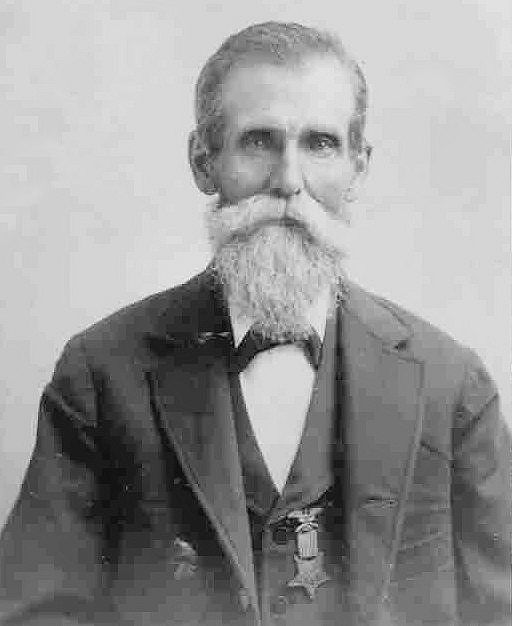
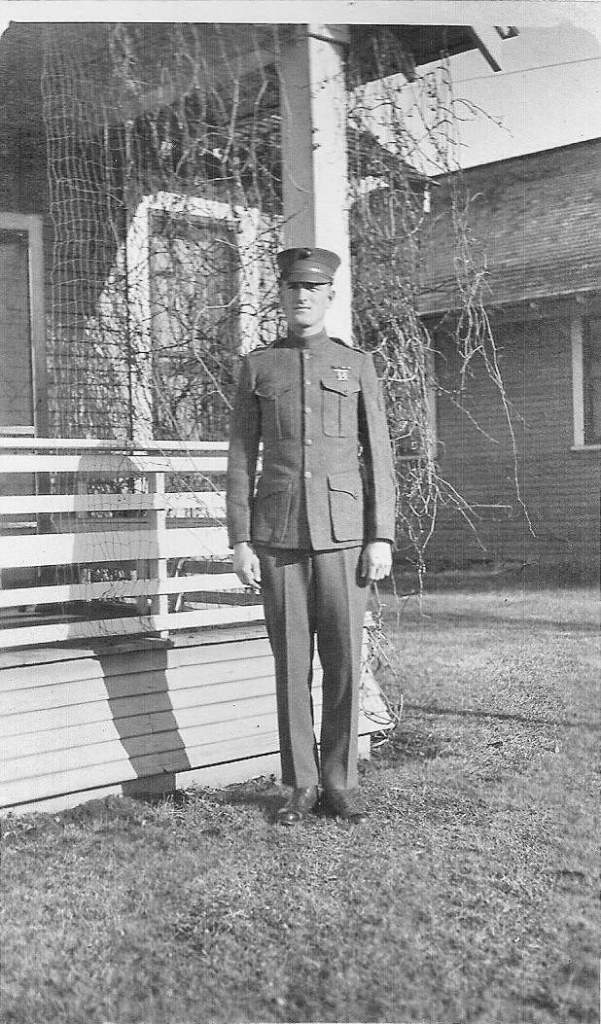
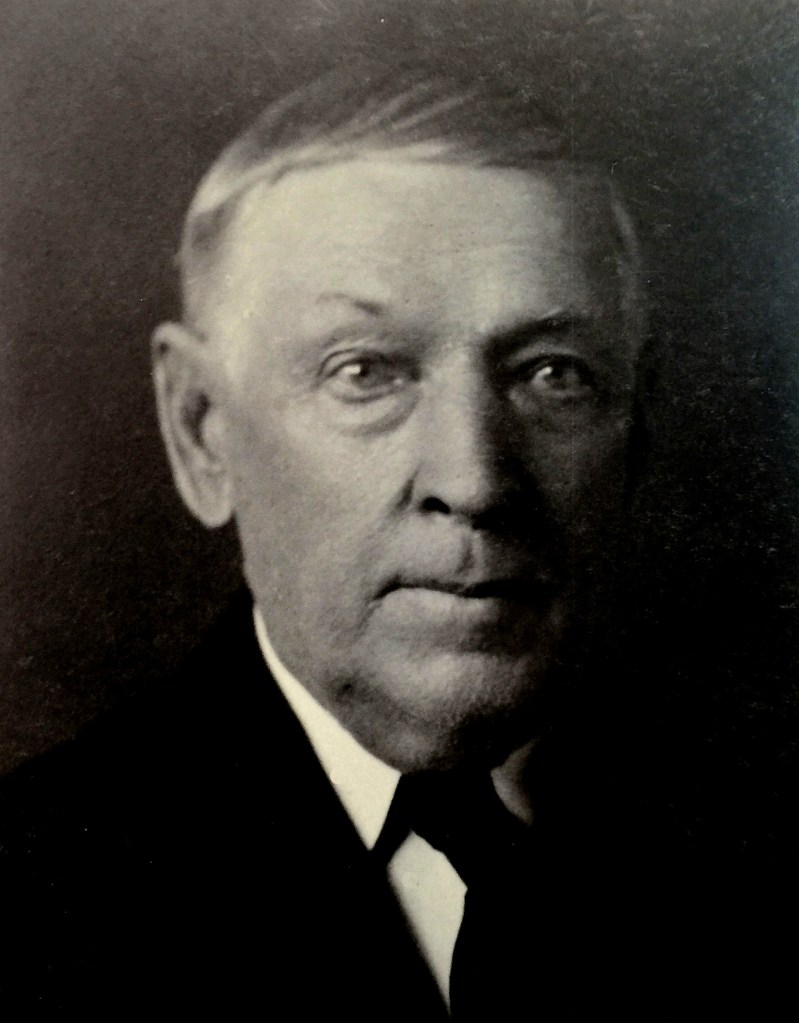
Today, also, I am thinking about two of my great-grandfathers whom I know were Civil War veterans, and my father who was a veteran of the United States Marine Corp during WWI.

Thomas W. Fenton, 1832-1901
My father’s paternal grandfather
Wounded in the Battle of Marks’ Mill
Cleveland County, Arkansas, April 25, 1864
Prisoner of War, Camp Ford, Tyler, Texas
My Father
Claude C. Fenton, 1896-1972
USMC, WWI
Adolphus A. Stuckey, 1838-1915
My father’s maternal grandfather
Emigrated to America from England, 1857, age 19
Enlisted in Illinois to serve in the Union Army
Honorably Discharged
Naturalized as a United States Citizen, August 24, 1865

I’ve put together a few thoughts to share with you today related to this holiday. I hope they will be meaningful for you as we remember loved ones who are no longer with us—plus toward the end of today’s episode I’ve included some important lessons we can consider.


Quite frankly, I don’t think I became aware of Memorial Day until I was about 13. That’s when I discovered that the Indianapolis 500 race was always held on Memorial Day. When we turned on the radio that morning in 1959, we discovered that the opening ceremonies were underway — and being broadcast live on our little local station KREW in Sunnyside, Washington.

Our family wasn’t really very race car oriented, but the Indy 500 was a pretty exciting event. We listened until the the race got underway. The announcers brought everything alive with their descriptions, and we could hear the sound of those powerful engines screaming around the 2.5 mile track.

But, we had other things to do that day, so we turned off the radio and headed out the door. When we returned a few hours later, I was amazed that the race was still on—although they were nearing the end.

I have no recollection of who the winner was—I suppose I could look it up—but somehow, listening to the Indy 500 back then brought an awareness of Memorial Day to me which I didn’t have up until that time.

And, even after that, it wasn’t until quite a few years later that the Memorial Day holiday began to take on a deeper, far more important meaning for me.
Eventually, I looked up the history to understand the reason it was part of our annual national calendar of events.


It seems there are several versions of how the holiday began. But, all historians agree that the movement to recognize a “day of remembrance” was an outgrowth of the American Civil War. In that terrible conflict over 620,000 Americans lost their lives. There was no community—large or small—that was not affected by the war, and fallen soldiers were buried in cemeteries from tiny church yards to huge tracts of land.

Suffice it to say, great grief touched nearly every home, every family, every city, town, and village in America.

Following the war, a movement sprang up—led largely by women, war widows and mothers who had lost their sons, daughters left without a father, and others who also sensed a deep loss of loved ones.

This movement was originally called “Decoration Day.” The graves of the fallen were decorated with flowers as symbols of love and appreciation for their efforts and sacrifice.


Out of all the stories telling how “Decoration Day” began, my favorite comes out of Charleston, South Carolina. Near the end of of the war, thousands of Union POWs were herded into makeshift camps near the city. Living conditions rapidly deteriorated, making life truly miserable for the prisoners.
One of these camps was on a former racetrack, where things got so bad that over 250 prisoners died from exposure. They were buried in a mass grave located behind the grandstand.

The end of the war began on April 9, 1865 when Robert E. Lee surrendered his Army of Northern Virginia to Ulysses S. Grant’s Union Army of the Potomac.
Just three weeks later, on May 1 of that year, more than 1000 people—the vast majority of whom were recently liberated slaves—gathered at the Charleston racetrack to consecrate a new, proper burial site for the fallen. The assembled group sang hymns, gave readings, and placed flowers around the cemetery, which they designated for the “Martyrs of the Race Course.”

“Martyrs of the Race Course”
Charleston, South Carolina
May 1, 1865
Recently liberated slaves gathered to honor Union soldiers
who died as Prisoners of War in Charleston.

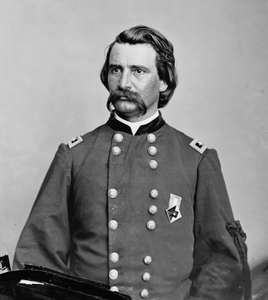
Three years later, General John A. Logan, commander-in-chief of Union Civil War veterans, issued a decree that May 30 should become a nation-wide day of commemoration for all soldiers killed in the conflict. General Logan was the one who gave the name “Decoration Day” to the holiday. Following the 1880s, the day was also often called “Memorial Day.”


May 30 then became the designated date for each annual “Memorial Day” for remembering those who paid the ultimate sacrifice in the course of their military service. In 1968, the Uniform Monday Holiday Act went into effect, which moved Memorial Day from May 30 to the “last Monday in May.”

Over the years, observance practices have expanded to not only to remember casualties of the Civil War, but to further include those lost in all American wars. Plus, many families now also decorate the graves of loved ones on Memorial Day—regardless of whether the deceased individual had any military experience or not.

Our Memorial Day holiday today has become a special time to pause for reflection, honor, and appreciation for the legacy of those we loved, and must not forget. I’d invite you to meditate for a few moments now, by listening to this simple bugle solo of “Taps.”

(P.S. Listen carefully to hear the birds also singing in the background. (Love it!)

USMC Bugle – “Taps”

So, let us consider a few lessons we must plant deep into the soil of our hearts.

  1. Freedom is not free.

The cost is dear—literally millions of lives have been lost to gain—and then preserve—our freedom. Rivers of blood have been shed for this sacred cause. The sacrifices have brought unspeakable pain and suffering. We stand today in the shadow of their wings. We must never forget:

“Some gave all, for Freedom is not free.”

2. The cost of our spiritual freedom is also beyond measure.

One of the early Christian “fathers,” Tertullian (c.155-c.AD 220) famously said, “The blood of martyrs is the seed of [of the church].”

In the Christian era, hundreds of millions of believers who stood firm, unwavering in their faith in Christ, paid the ultimate price with torture, persecution, and death.
Our heritage of faith has been delivered to us at the cost of immeasurable personal sacrifice by our spiritual forebears.

Our freedom in Christ must never be taken for granted. Let us resolve therefore—in the power of God’s grace and the risen Christ—

  • To never forget the cost of our freedom (both spiritual and political);
  • To live with integrity, dignity, and honor, regardless of challenges, persecutions, or personal pain;
  • To cherish the ultimate promise found in Revelation 2:10 —

“Be faithful unto death, and I will give you the crown of life.”


Thank you so much for listening today! I pray you have been blessed.

Next week I’m going to tell you about a hugely popular author I’ve come to enjoy over the last few years, and share some glimpses into several of his books that I have found quite profound and thought provoking. I think you will enjoy knowing about them, too.
I hope you can join me for that.

God bless.

Greetings once again friends! This is Episode four of the podcast. The title of this week’s episode is “My Life-long Friends.”
This is the third of a three-part series focusing on and exploring our understanding of God—including thoughts about the Trinity: God the Father, God the Son, and God the Holy Spirit.


In the Fall of 1951, my parents enrolled me in First Grade at Outlook Grade School, which was located less than a mile from our house. I was pretty excited to start school. My older siblings were already in school, and I was anxious to join them. During the two years after my brother Beryl started, Mother “home-schooled” me, teaching me to read, so by the time my turn came I was primed and ready to go!

Outlook Grade School
Near Outlook, Washington, USA
Circa 1940s-1980s

I’ve always been an outgoing, social person, so I loved being with the other first-graders. Other kids my age from around our farming community were there, and we quickly formed bonds of friendship—some of which still continue to this day.

There were other boys, like Billy, Alonzo, Robert, Larry, Paul, and Leon. Some of the girls were Linda, Judy, Lois, and Renee. A lot of our first-grade classmates are no longer with us. Others I’ve lost all contact for them and have no idea if they are even still living. But, there are a few others with whom I’m still friends all these years later.

Plus, we added some classmates during those early elementary school years, too—kids like Raymond, Phil, and Tony.

Quite a few years back, Ruth and I were living in Ohio, and I got a letter announcing a planned reunion for my Outlook class. I was excited! I really wanted to go, but it was on too short of a notice, and I was unable to change my schedule.

I decided, however, that although I couldn’t be there in person, I could record a video and send my greetings to all of them that way. It worked! And I was delighted a few weeks later to get a return tape from the group with a personal greeting from each one present. That was pretty cool!

The next year, however, when the class planned another gathering, I determined to go. I did, and it was wonderful connecting in person with each of those friends from our childhood days.

There’s just nothing quite like being there!


I have to digress here for a moment to share a story about the value of “being there.”

Back in the 1960s, Dan Hanna, Sr. was a legend in his own time in and around Portland, Oregon. Dan was the person who developed the idea of a drive-through car wash. He began in 1955 with one unit in Milwaukie, Oregon—a suburb of Portland. Four years later by 1959, Dan Hanna’s “Rub-a-Dub” Carwash locations had expanded to 31 in and around Portland.

Dan began to get national attention and was able to start marketing his systems to other places. In record time his company was selling and installing “Rub-a-Dub” equipment nationwide. He far outsold and outpaced every other competitor in the field.

Although there were many reasons someone would want to by “Rub-a-Dub” equipment, Dan Hanna had one winning factor his competitors lacked.

He owned a Learjet.

An early-model Learjet 23, similar to the one in the story.

When a phone call would come in with someone inquiring about purchasing a “Rub-Dub” carwash system, Mr. Hanna would take the call himself. A typical conversation might go something like this:

Hanna: “Where did you say you are located?”

Caller: “Fargo, North Dakota.” (It could have been anywhere in the country.)

Hanna: “Great! Let me see . . . I see your main airport there is Hector International. I could meet you there in about three hours. Would that work for you?”

Caller: “Sure! I can do that.”

Hanna: “Okay. I’ll see you at the airport this afternoon!”

With that, Mr. Hanna would take off in the Learjet and head for Fargo. He’d meet with the prospective customer, maybe even take him for a ride in his super-impressive plane, and return to Portland with another signed-and-sealed deal to deliver and install a “Rub-a-Dub” system, this time in Fargo, North Dakota.

There’s just nothing quite like “being there.”


So, what’s all this have to do with “life-long friends,” and our understanding of God?

It’s all in that one sentence: “There’s nothing quite like being there.”

If you want to have the greatest and best connection with friends—whether from recent times or from long ago—there’s nothing quite like being with them in person!

If you are a business person or in sales, regardless of your product, there’s nothing quite like meeting your prospective customer directly.

There’s just nothing quite like being there!

And, our God, the Great God of heaven and earth, knows that.


In the Garden of Eden the Creator came “in the cool of the day” (Genesis 3:8) because He wanted to be with Adam and Eve in person.

Following the entrance of sin, Adam and Eve had to be separated from God because sin cannot exist in the presence of a holy God. They were expelled from the Garden in order to preserve their lives—and to make it possible for God’s already-in-place Plan B—the Plan of Redemption and Salvation—to go into effect.

Even so, the Creator still wanted to be with them, to fellowship with them, and to teach them so many things He wanted them to know.

To that end, God preserved Noah and his family from destruction in the Flood. He continued His presence in the human experience through the line of Noah’s son Shem. Centuries later, God entered into a covenant with Abram—whose name was later changed to Abraham. Abraham became known as “the friend of God,” and everywhere Abraham journeyed he built an altar to Yahweh.

Then, a few more centuries pass until some of Abraham’s descendants (through Isaac and Jacob—aka “Israel”) are led by God out of Egypt in the Exodus.
At Mt. Sinai, God instructs Moses, “Let them make me a Sanctuary, that I may dwell among them” (Exodus 25:8).

God wanted to be with His chosen people.

At the dedication of Wilderness Tabernacle—and later at the dedication of Solomon’s Temple in Jerusalem—The Shekinah glory of God’s presence literally moved in and took up residence!

The very real presence of God was right where He wanted to be—living just next door to them, first in the Most Holy Place of the Tabernacle, then in the Temple.

It was God’s great desire to be and become Israel’s “Resident God.” There He could live in their “neighborhood,” and help them grow into His design that they should be “a nation of priests” to represent Him and His love, mercy, and grace to all the rest of the world.

Eventually, of course, the “Resident God” came to Earth in the person of Jesus, born of the Virgin Mary. He lived as a man among men—one of US—not only living “next door” in the presence of the Shekinah glory, but actually walking in human flesh, fully God, but also fully man.

After Jesus’s death, burial, and resurrection, He ascended back to Heaven where, as the Book of Hebrews tells us, He serves as our Great High Priest, representing Adam’s race to the Father, and sending the gifts of the Father’s love back to us.

Before Jesus left to go back to the Father’s side, He promised to send “another Counselor, the Holy Spirit,” to live—not only with us, but in us! For all who willingly open their spiritual heart, the Resident God will come and take up residence.

What an incredible prospect! The “Friend” who sticks “closer than a brother” knows full well, there’s nothing quite like being there!” And, through the Person of the Holy Spirit, the God who loves you, saves you, guides you with wisdom, and gives you strength, also gives you His promise, “I am with you always, even to the end of the age” (Matthew 28:20).

Here’s what the Apostle Paul had to say about this: “When the Holy Spirit controls our lives, he will produce this kind of fruit in us: love, joy, peace, patience, kindness, goodness, faithfulness, gentleness, and self-control. Here there is no conflict with the law” (Galatians 5:22, 23).

And, writing to the Colossians, Paul says, “It has pleased God to tell his people (the Jews) that the riches and glory of Christ are for you Gentiles, too. For this is the secret: Christ lives in you, and this is your assurance that you will share in his glory” (Colossians 1:27).

So, we see through the Bible’s testimony that the work of the Holy Spirit is to make the presence of God known at all times and places.

  1. At the time of Creation, the Spirit moved upon the face of the waters.
  2. At the time of the Incarnation, the Spirit moved upon Mary to bring forth her Holy Son.
  3. And, at the time of a “new birth,” the Spirit moves upon the sinner’s heart to bring forth new life.
  4. It was the Spirit who inspired the ancient prophets to write the messages of Scripture.
  5. It is the Spirit that gives energizing power for ministry and service in God’s Name.

Yes, God knows.

There’s just nothing quite like “being there.”


And, that’s really where we come into the picture. In the Name of God, and moved by the Holy Spirit, we are sent as ambassadors of grace to a world of ungrace. We are to be carriers of hope to a world without hope.

In the words of Jesus’s prayer, we are to be “in the world, but not of the world.”

For what purpose? Why are we to be “in the world?”

Because,

there’s just nothing quite like being there

accompanied by our life-long Friend, and carrying Him with us into a world He longs to redeem and save.


Thank you so much for listening today! I pray you have been blessed.

Next week’s episode is scheduled to post on Monday, May 31—a day set aside to remember and honor the memory of deceased American military personnel. I will be sharing a special Memorial Day message in that post. Be sure you are subscribed to the podcast, then watch your email or text messages letting you know when it’s ready.

I hope you can join me for that.

This is Episode three of the podcast. The title of this week’s episode is “My Brother’s Love.” This is the second of a three-episode series focusing on and exploring our understanding of God—including thoughts about the Trinity: God the Father, God the Son, and God the Holy Spirit.


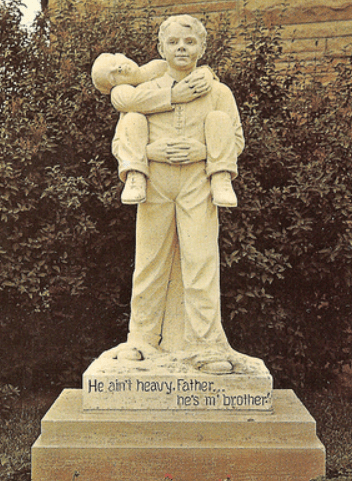
On the campus of Father Flanagan’s Boys Home near Omaha, Nebraska, there stands a small statue of one young boy carrying another on his back. It’s not entirely clear from the statue, but the reason for the one boy carrying the other is that the smaller one is crippled. His legs didn’t function well, and he had difficulty walking.

“He ain’t heavy, Father . . . he’s m’ brother!”
Located at Father Flanagan’s Boys Home
Boys Town, Nebraska, USA

One day, as Father Flanagan was walking across the campus, he saw this scene in real life with the older, stronger boy carrying his friend. The priest stopped and chatted with the two for a few minutes.

In the course of the short conversation, Father Flanagan remarked to the older boy that it must be difficult to carry someone else around on his back like that.

The young man answered, “He ain’t heavy, Father. He’s m’ brother!”

Those words are inscribed on the base of the statue commemorating that momentary, but profound statement.
Father Flanagan was so struck with the wisdom and attitude of this student, and his cheerful love for the younger boy, that he shared the story far and wide to illustrate the mission of Boys Town, USA. Eventually, that little encounter grew into a major theme for the ministry.

I have personally visited Boys Town and have seen that statue with my own eyes. Such a beautiful concept—expressed in real life for one young man for another!

“He ain’t heavy, Father! He’s m’ brother!”


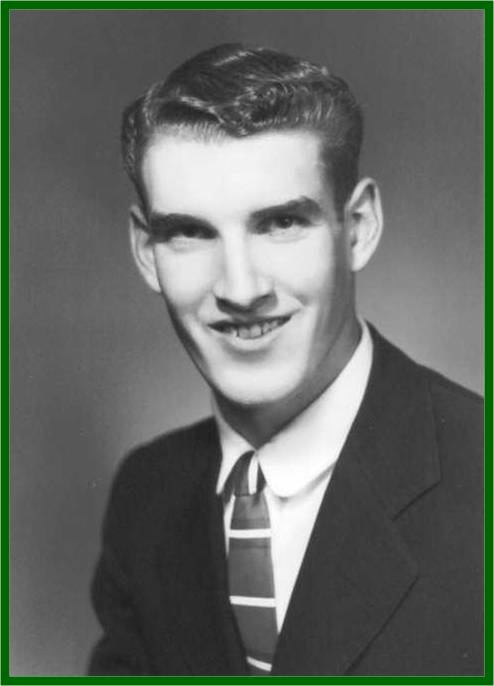
Last week I shared a bit about my childhood home—a big old house in the farming community near Outlook, Washington. I mentioned that I was the fourth of four children born to Claude and Oral Fenton. I had two older sisters and a brother that was about 28 months older than me.

Beryl Dean Fenton, 1943-1986
Senior Photo, Sunnyside High School
Sunnyside, Washington, USA

I guess we had a fairly normal brother-to-brother relationship. We were totally loyal to each other, but between the two of us, we were pretty fierce, struggling competitors. We did “carry” each other—as brothers will—but we also had some pretty horrific fights!
Beryl was more athletic than me. He did much better in active sports, for instance, than I ever could. He loved basketball. I was more of a football lineman type.

He was also a much superior musician. He played the 120 bass, piano keyboard accordion very well, and he could tell instantly if I played a wrong chord on my guitar after I learned to play it in later years.
When he got married, Beryl asked me to be his best man. And, when my turn came a few years later I was proud for him to stand with me at my wedding, as well.

When I finished Seminary training with my Master of Divinity degree, I can still hear the admiration in his voice as he said, “Loren, I am proud of you!” You can’t imagine how much that meant to me then, and still means to me now.

Sadly, Beryl’s life ended far too soon. He died at the early age of 43 from liver failure. We never found the cause for his condition. It was a sad day for our family and his many friends when he breathed his last.

His life impacted the lives of people from all levels of society in the Yakima Valley, from bankers and businessmen, to fellow farmers and hired hands, to his Native American neighbors of the Yakama Indian tribe, to his high school classmates, as well as extended circles of family, friends, and loved ones.

My brother Beryl was well loved. And I know he loved me. If it would ever have been necessary for him to carry me for whatever reason, I know I could have heard him gladly say, “He ain’t heavy. He’s my brother!”


And, yet, the Bible tells us that we have a “friend that sticks closer than a brother” (Proverbs 18:24). That “friend” is Jesus. He even calls us his brothers and sisters!”

So now Jesus and the ones he makes holy have the same Father. That is why Jesus is not ashamed to call them his brothers and sisters (Hebrews 2:11 NLT).

The Old Testament Isaiah’s prophetic pen recorded these immortal words nearly 700 years before the birth of Jesus:
For unto us a Child is born, unto us a Son is given; and the government will be upon His shoulder. And His name will be called Wonderful, Counselor, Mighty God, Everlasting Father, Prince of Peace (Isaiah 9:6).

The child of Isaiah’s prophecy was Jesus, who is also called Immanuel, “God with us.”

He was, in fact, the One who created the heavens and the earth. Colossians 1:16-17 says, By Him [Jesus] all things were created that are in heaven and that are on earth, visible and invisible . . . And He is before all things and in Him all things consist.
Jesus was the “Word” of God.

In the beginning was the Word, and the Word was with God, and the Word was God. He was in the beginning with God. All things were made through Him, and without Him nothing was made that was made (John 1:1-3).

The Word became flesh and dwelt among us, and we beheld His glory as of the only begotten of the Father, full of grace and truth. (John 1:14).

Let’s pause just a moment and consider what it means for Jesus to be called “the only begotten of the Father.”
This expression is translated from a Greek word, monogenes, which, literally translated, means “the only one of a kind.”
In other words, because Jesus is both fully human—and fully God—he is totally unique. There is no one else in heaven or earth that is like him. He is completely “like us” in his humanity, but he is also completely “like God” in his divinity.

As a human, standing in for Adam, Jesus won the victory over temptation and sin where Adam failed, gave up his life as the sacrificial lamb that takes away the sin of the world (John 1:29), and ascended to heaven as our “Elder Brother” where he serves as our Great High Priest in the Heavenly Sanctuary.

The writer of the New Testament Book of Hebrews says this:

So then, since we have a great High Priest who has entered heaven, Jesus the Son of God, let us hold firmly to what we believe. This High Priest of ours understands our weaknesses, for he faced all of the same testings we do, yet he did not sin. So let us come boldly to the throne of our gracious God. There we will receive his mercy, and we will find grace to help us when we need it most (Hebrews 4:14-16 NLT).

The Apostle Paul wrote to the Christian believers in Ephesus, [God the Father] seated Him [Christ] at His right hand in the heavenly places, far above all principality and power and might and dominion, and every name that is named, not only in this age but also in that which is to come (Ephesians 1:20).

Then, a few verses later, Paul writes, [God] raised us up together and made us sit together in the heavenly places in Christ Jesus. (Ephesians 2:6)

And Jesus himself told the disciples after his resurrection, All authority [power] has been given to me in heaven and on earth (Matthew 28:18).


So, let’s summarize and review these few thoughts about Jesus:

  • Jesus is completely at peace calling you and me his brothers and sisters.
  • The child of Isaiah’s prophecy was Jesus, who is also called Immanuel, “God with us.”
  • He is the “Word” of God—the One through whom all things were created and are sustained.
  • He is the “monogenes”—the “only one of a kind”—the “only begotten Son” of the Eternal Father.
  • He is the “lamb of God who takes away the sin of the world.”
  • He is our great High Priest in heaven today, representing our needs to the Father of grace and truth, and delivering the gifts of the Father’s love to us through the constant presence of the Holy Spirit.

I can almost imagine Jesus telling the Father about me, “He ain’t heavy, Father. He’s my brother!”

Indeed, friend. Jesus is our heavenly brother who loves us more than any cost or any trial. The Son of God came to Earth and became the Son of Man so he could take our place on the cross of sin and shame. In exchange for our record of sin, he gives us his own record of righteousness.

All we have to do is accept his invitation to join the family.

I’d invite you to do that right now, right where you are. Just say to him, “Jesus, I confess that I am a sinner. I need your forgiveness, and I accept your gift of purity, righteousness, and your promise of eternal life. Please, come into my heart as you have promised. Amen.”

And I can almost hear the Savior say, “Welcome home, my brother! Welcome home, my sister! Welcome home!


Thank you so much for listening today! I pray you have been blessed.

Next week we’ll conclude this short series focused on understanding more about God the Father, God the Son, and God the Holy Spirit. Our study next week will be about God the Holy Spirit. I hope you can join me for that.

Greetings once again friends!

This is Episode two of the podcast. The title of this week’s episode is “My Father’s House.”

This is the first of a three-episode series focusing on and exploring our understanding of God—including thoughts about the Trinity: God the Father, God the Son, and God the Holy Spirit.

I thought I’d begin today by sharing a little bit about my childhood home.

As some of you already know, I was the youngest of four children growing up on our family farm near Outlook, Washington, located east of the Cascade Mountains in the farmlands of the Lower Yakima Valley.

Our house was a big, old farmhouse with a distinctive, almost classic structure.

Some of you might like to see a photo of the old house, although this shot is from a later time after our family no longer lived there. But, you can get a good idea of what it looked like.

Historic Fenton Family Home
North Outlook Road
Outlook, Washington, USA
1945-1985

Our family lived there for forty years! My parents and three older siblings moved in about two months or so before I was born. I grew up in that house and lived there until leaving for college when I was 18. My mother continued living there after my father passed away until she could no longer live alone. At that time the house was sold, and the Fentons no longer had a presence there.

In the minds of many community old-timers, however, the old house on North Outlook Road is still “the Fenton house.”
I’ve driven by it a number of times through the years, primarily just to take a little trip down memory lane. That house holds a truckload of childhood memories for me.

(A poem by Edgar A. Guest from a generation ago comes to mind—“It takes a heap o’ livin’ in a house to make it a home.” And that certainly was true for our house.)

It provided shelter from the storms of life, both literal and social.

We experienced times of great laughter, and many tears.

That place quite literally became the Center of my World! It was a base for all the dreams of my childhood and teenage years.
In later years, wherever I was in some distant place—even overseas— I always figured out how far it was back home to Outlook. And, still today, whenever I chance to drive past, there is a tug at my heart because my roots grew so deeply there. Recently someone has begun some repair and restoration on it. I’m looking forward to how that turns out!

But, enough of nostalgia, let’s move on.

Truth be told—as much as I loved the place where I lived all during my growing-up years, from those early days of life until this very moment right now, I’ve been learning about another “home” waiting for me “just over the hilltop.”
Our Heavenly Father has a place prepared just for me — and for you, too(!) — in the beautiful Earth Made New that John wrote about in the Book of Revelation, chapter 21.

Here’s another wonderful promise I dearly love, found in the Old Testament:

1He who dwells in the secret place of the Most High shall abide under the shadow of the Almighty. 2I will say of the Lord, ‘He is my refuge and my fortress; my God, in Him I will trust’ (Psalm 91:1-2 NKJV).

In this verse, an unknown ancient song writer identifies the “dwelling place” of the person who believes in and puts his/her trust in God. That “home”—that “abiding place”— is in the “secret place of the Almighty.”

The word “Almighty” here is translated from the Hebrew language expression El Shaddai.

According to Strong’s Hebrew and Aramaic Dictionary, the title Shadday (sic) really indicates the fullness and riches of God’s grace, and would remind the Hebrew reader that from God comes every good and perfect gift—that He is never weary of pouring forth His mercies on His people, and He is more ready to give than they are ready to receive.

(That quotation is from Strong’s word listing #7706, for all you Bible students who may be into dictionaries and concordances and similar reference materials.)

All I can say is, “Wow!”

I’ve always understood “El Shaddai” to simply mean “The Almighty,” indicating the great Creator God’s ability to accomplish anything and everything He wanted or decided to do.

Okay, all that might be well and good, but here Strong’s dictionary expands that basic idea with the focus on God’s limitless mercy and grace!

The “secret place of the Most High”—the very heart of God—is our spiritual home!

That “place” is the unquenchable fountainhead of everlasting agape love—the inexhaustible source of Creation, forgiveness of sin, restoration, and renewal.

No wonder the Apostle Paul exclaimed, I am convinced that nothing can ever separate us from God’s love. Neither death nor life, neither angels nor demons, neither our fears for today nor our worries about tomorrow—not even the powers of hell can separate us from God’s love. No power in the sky above or in the earth below—indeed, nothing in all creation will ever be able to separate us from the love of God that is revealed in Christ Jesus our Lord (Romans 8:38-39 NLT).

And, again, By grace you have been saved through faith, and that not of yourselves; it is the gift of God, not of works, lest anyone should boast (Ephesians 2:8-9 NKJV).

So, let’s explore a few more verses in the Bible that help us know even more about our heavenly home, and even more specifically, truths we can discover about our Heavenly Father.

Luke 15:11-31 records Jesus’ parable about a lost son—commonly referred to as “The Prodigal Son.” Much of the story focuses on the arc of the son’s life—from restless farm kid to party animal in a “far country” to his tearful, repentant return to his father’s house.

However, I’m thinking this story should be labeled “A Father’s Unconditional Love.” My guess is that most of you listening to this podcast are already familiar with this story. It’s one of the most repeated stories of the New Testament.
If you happen to NOT know the story—and even if you HAVE heard it countless times—I’d encourage you to get your Bible, look up Luke, chapter 15, and read it again.

In my book My Seven Essential Daily Prayers I speculate in one place about the possibility that a young Jesus working with his earthly father Joseph may have become acquainted with the family of the two boys in his story.

Right during the time when Jesus was growing up in Nazareth, the regional so-called “king” of Galilee undertook the rebuilding of a city called Sepphoris as the capital city. It was a project that took many years from start to finish.

Sepphoris was only about five miles north of Nazareth, the home of Joseph, Mary, and Jesus. A great construction project like this would certainly need skilled workmen—including carpenters and other tradesmen. If, in fact, Joseph worked to help build Sepphoris, it is not unlikely that his young son Jesus might accompany him to the job sites to help with the work and, in the process, learn the carpenter’s trade.

With the swelling population, there would also be a critical need for farm produce to supply the food markets in town.
We know from Jesus’ story about the young prodigal that his family were farm people. They had hired workers, servants, some cattle, and undoubtedly grew some food crops as well. We actually don’t know the location of their farm, but Galilee around the area of Nazareth and Sepphoris was rural, farm country.

And again, it’s only speculation on my part, but I like to think that perhaps the young Jesus working with Joseph, and the two boys of his parable accompanying their parents to deliver food to the markets in Sepphoris, may have become acquainted there—perhaps even counting each other as friends.

But, back to the story itself—and what it says about our Father God.

First, the father never gave up hope for his son’s return. When he saw the boy coming down the road—starving, filthy, and dressed in rags—he RAN to gather him into his arms.

Love and grace won the day, and lavish gifts poured from the father’s rejoicing heart. His own robe. His own ring. His own sandals for the barefoot boy. Strike up the band! It’s time to sing and dance. “This my son,” he cries, “was dead and is alive again; he was lost and is found!” (vs. 32).

What a beautiful illustration of our Heavenly Father!

The Apostle Paul writes, Because you are [adopted] sons, God has sent forth the Spirit of His Son into your hearts, crying out, “Abba, Father!” Therefore you are no longer a slave but a son, and if a son, then an heir of God through Christ (Galatians 4:6-7 NKJV).

And, Jesus instructed his followers, When you pray, do not keep on babbling like pagans, for they think they will be heard because of their many words. Do not be like them, for your Father knows what you need before you ask him (Matthew 6:7-8 NKJV).

A few chapters later Jesus says, Are not two sparrows sold for a copper coin? And not one of them falls to the ground apart from your Father’s will. But the very hairs of your head are all numbered. Do not fear, therefore; you are of more value than many sparrows (Matthew 10:29-31 NKJV).

Are you beginning to get the picture of how much your Heavenly Father loves you? I don’t know about you, friend, but as I think seriously and deeply about God’s immeasurable love and grace He has for me, I am just blown away!

“Wide, wide as the ocean,
High as the heavens above,
Deep, deep as the deepest sea
Is my Savior’s love.
I, though so unworthy,
Still am a child of His care,
And His love teaches me
That His love reaches me
Everywhere!

Now, there’s one more thing we need to look at before we close out this little study about our Father God.
Reading through the Bible you will find many names for God. Twelve of these names in the Old Testament begin with “Yahweh” (or “Jehovah” in the old KJV). Then, each of these twelve names are hyphenated with another word which expands our understanding of God’s nature.

Being the curious person I am, I wondered—what might be the underlying root meaning of “Yahweh.” Again, Bible dictionaries and concordance prove their worth!

The ancient Hebrew word for God’s name is known as “the Tetragrammaton.” IT contains only four letters—all consonants. If you speak with someone well-versed in biblical languages, and mention the “Tetragrammaton” that person will know immediately what you are talking about.

The Tetragrammaton is often translated simply as “LORD” (using all caps) in our English-language Bibles. The purpose of using all caps is to indicate that the Hebrew source-word is the Tetragrammaton, rather than other commonly used words which are also translated “lord,” but are based on other Hebrew words.

In the English alphabet, letter for letter, the word is spelled “YHWH.”

Checking a Bible dictionary that indicates root words for individual listings, I discovered this: One of the underlying roots of YHWH carries the implication of finishing a task, or a job.

The very first time this name is used in the Bible is at the end of Creation week following the statement that God “finished” all the work of Creation, and then declared it “very good.”

So, for me, it makes perfect sense to paraphrase God’s name Yahweh into “The God Who Finishes What He Starts.”
God not only finished the work of Creation, but at Calvary Jesus cried out, “It is finished!” indicating that the divine plan of redemption for Adam’s fallen race was now completed. Christ had won the victory over sin, and the way of salvation was now permanently open.

That’s truly wonderful, but there’s one more thing we also have to know.

The Apostle Paul wrote to the believers in Philippi these encouraging words: He who has begun a good work in you will complete it until the day of Jesus Christ (Philippians 1:6).

I don’t know about you, friend, but that promise brings me great courage! I love the string of letters that goes “PBPGINFWMY!” Which means, “ Please be patient. God is not finished with me yet!”

I’m so glad God continues to work with each one of us. The Father’s amazing grace, agape love, and unfailing providence truly declare to us that He is worthy of worship.

Once again, thank you so much for listening today! I pray you have been blessed.

The title of next week’s episode is “My Brother’s Love.” The focus will be on Jesus as the Word of God, the Second Person of the Godhead, and Savior for all of Adam’s race.

I hope you can join me for that.

Also, a reminder, the regular schedule for posting each weekly episode of the podcast is now every Monday.

O Lord of Heaven, Earth, and Sea
The beauty of your Creation is beyond expression.


Beasts of the forest roam the hillsides with untold majesty.
Towering trees lift their branches in testimony of your power, sheltering tiny birds within their leaves
The restless ocean waves break ceaselessly onto sandy beaches, but must ever recede at your command,

“Thus far and no farther.”


So, for this I praise you, O Lord!
When the relentless tide of evil threatens to overwhelm and destroy my faith, you declare its bounds, and force it back by your command,

“Thus far and no farther!”

Segment I

First, it’s a awesome to have you join me for EPISODE #1 of the GoodlifeNews! Podcast!

I’m so glad you are here! I am excited about where this little project might lead—because I really believe we can build a meaningful community growing together in understanding and experiencing the life God designs for us.

I read a remark somewhere that it doesn’t matter where you’re coming from—it’s where you are going that counts! And that’s true! Regardless of your background—good or bad—God has a plan and purpose for you! Moving forward in faith to follow His lead you can’t go wrong. He will get you to where you have always wanted to be in your heart of hearts

Our theme for this episode is “God’s Amazing Grace.”

In my personal spiritual journey the last few years I have sensed a constant deepening amazement at God’s amazing grace “that saved a wretch like me.”

About a year ago, I was struck by an expression used by the Apostle Paul in one of his early letters found in the New Testament.

Here it is:

“The fruit of the Spirit is love, joy, peace, patience, kindness, goodness, faithfulness, gentleness, and self-control” (Galatians 5:22-23).

Seriously, I have preached on this text dozens of times. I have written about it and quoted it more times than I can remember.

But, then while reading it again, this thought popped up in my head:

The primary purpose for the fruit is to reveal the truth about God through our connections and relationships.

That is to say, the gift of these fruits is not just to make us better people and get us ready for heaven!

The gift is not just about the transformation of our character.

Instead, the fruits are to equip us for truthful, faithful witness about God’s love and grace, enabling us to be loving and gracious as we discourse with others.

“‘You are my witnesses,’ declares the Lord, ‘and my servant whom I have chosen'” (Isaiah 43:10)

What do our daily lives reveal about God’s amazing grace? Just a question to think about and meditate on.

Here’s another: How do we get to the spiritual place where those “fruits” become part and parcel of who we are?

Let me offer a couple of ideas for your consideration:
The “fruit” of the Holy Spirit will not—CAN not—be manifested in a person’s life unless—and until—the Holy Spirit is actually present in the heart!
The Holy Spirt comes into the heart ONLY by invitation.

In the vision of Revelation Jesus tells John, “Look! I stand at the door and knock. If you hear my voice and open the door, I will come in, and we will share a meal together as friends” (Revelation 3:30 NLT).

Obviously, Jesus is speaking here of the door to the spiritual heart. And how does Jesus come into our heart?

Well, here’s his answer in the Gospel of John:

Jesus told his disciples, “All who love me will do what I say. My Father will love them, and we will come and make our home with each of them. . . . I am telling you these things now while I am still with you. But when the Father sends the Advocate—that is, the Holy Spirit—he will teach you everything and will remind you of everything I have told you” (John 14:23-26 NLT).

A few verses earlier in that same chapter Jesus said this: “I will ask the Father, and he will give you another Advocate, who will never leave you. He is the Holy Spirit, who leads into all truth. The world cannot receive him, because it isn’t looking for him and doesn’t recognize him. But you know him, because he lives with you now and later will be in you” (John 14:16-17).

Okay, so let’s review what we just covered:
1. God has a purpose for your life
2. The indwelling presence of the Holy Spirit produces spiritual “fruit” to empower your witness about God’s amazing grace
3. The Holy Spirit is sent to us from God the Father as the representative of Jesus
4. The Holy Spirit enters our heart by only our invitation

In the next segment I’ve got a very special guest to introduce to you. Together we’ll focus on ways to open our heart’s door to invite Jesus to come in.

Segment II

This segment is the live interview with my wife Ruth Fenton. It was not scripted.

Segment III

Thank you so much Ruth! Sharing your thoughts and experience will be a great blessing to many people, I’m sure!

I want to pivot now to share an experience I had several years ago while I was pastoring in Oregon.

Every year in the week following Thanksgiving, for 5 days the Oregon Conference sponsored a pastors’ prayer conference at Cannon Beach on the Oregon coast. These were always times of incredible camaraderie, relaxation, fellowship, and just awesome inspiration. The Oregon coast is always spectacular, and the stretch near Cannon Beach is no exception. A hike on the beach at low tide could almost be classed as an act of worship! It truly is a beautiful place.

One of the features of this retreat agenda was a full day without programming! No meetings after breakfast, then no group gathering until supper time. The entire day was intentionally set-aside for each of us to spend “A Day Alone With God.” At the end of the day we came together to share communion and an “agape feast.” Together we would sing, share testimonies of our experience, and pray both together as a group and as individuals praying for each other for personal needs.

Let me tell you, every year this “day alone with God” was the highlight of our retreat experience! It was absolutely wonderful!

At breakfast, we were handed an outline of suggested activities for the day. Of course, we were truly on our own to do or not to do whatever we decided. But, the organizers knew that some simple instructions could be helpful.

If you would like to see the outline visually, I’d encourage you to visit the website list of blog posts and look for the entry “A Day Alone With God.


To finish up today, I decided to share a couple of original psalms I wrote on one of those very special days from years ago. These were originally dated Wednesday, November 30, 2005. I have made some slight revisions to share with you today.


Here’s the first:
A Psalm of Praise
O Lord of Heaven, Earth, and Sea
The beauty of your Creation is beyond expression.
Beasts of the forest roam the hillsides with untold majesty. Towering trees lift their branches in testimony of your power, sheltering tiny birds within their leaves
The restless ocean waves break ceaselessly onto sandy beaches, but must ever recede at your command, “Thus far and no farther.”
So, for this I praise you, O Lord, that when the relentless tide of evil threatens to overwhelm and destroy my faith, you declare its bounds, and force it back by your command, “Thus far and no farther!”
Amen.

The second psalm is simply titled,
A Psalm of Supplication
I have long walked with you, O Lord. For threescore years my heart has been captive to your love.
Many have been the times of refreshing. Many have been the seasons of joy!
But to my shame, Lord, I know I wandered from your side. I chased pretty rainbows And found only dust and broken dreams.
Still, I rejoice in your restoration power!Your grace showers me with renewal and hope.
Lord, I long for the thrill of your touch. I hunger for that fire I felt in early years.
I am waiting, Lord.
Amen.

I have long walked with you, O Lord.
For threescore years my heart has been captive to your love.


Many have been the times of refreshing.
Many have been the seasons of joy!


But to my shame, Lord,
I know I wandered from your side.
I chased pretty rainbows
And found only dust and broken dreams.


Still, I rejoice in your restoration power!
Your grace showers me with renewal and hope.


Lord, I long for the thrill of your touch.
I hunger for that fire I felt in early years.


I am waiting, Lord.